
You know your current legacy system is costing you money. You know FX volatility is eating your budget, and your agents are limited by hardware. But there is one thing holding you back: The fear of downtime. A complete Contact center migration guide Nigeria .
In the Nigerian market, where customer loyalty is hard-won, being “offline” for even an hour is not an option. At Smart Cloud Contact, we’ve perfected a migration roadmap that ensures your transition is invisible to your customers but transformative for your bottom line.
Step 1: The Infrastructure Audit (What to Keep vs. What to Kill)
Before moving to the cloud, we look under the hood. Not everything in your old “Server Room” needs to move.

- The Audit: We map your existing call flows, IVR scripts, and third-party integrations, including your CRM and local databases. Review our guide to CRM and contact center integrations in Nigeria to understand how these systems can work together.
- The Goal: Identify bottlenecks. If your current IVR is too complex and leads to high drop-off rates, we don’t migrate the problem—we fix it before the move.
Review our guide to CRM and contact center integrations in Nigeria to understand how these systems can work together.
Step 2: Designing Your “Naira-Proof” Architecture
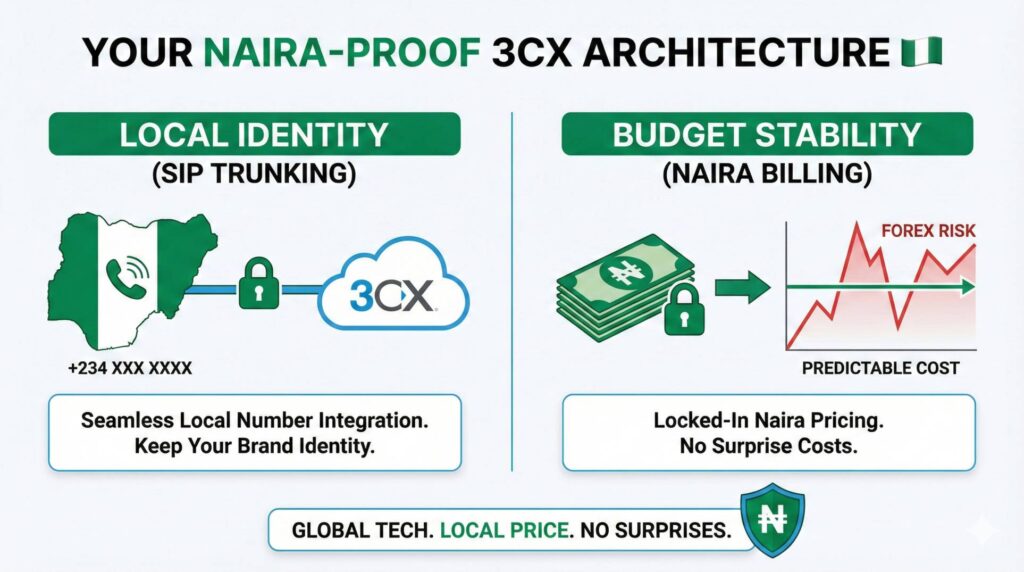
This is where we customize your 3CX-powered environment.
- Local SIP Trunking: We ensure your local Nigerian phone numbers are integrated seamlessly so you don’t lose your identity.
- Budget Stability: We lock in your Naira-based billing, ensuring that while you get global-standard software, your costs stay predictable regardless of the Central Bank’s next move.
Step 3: The Parallel Run (The “Zero Downtime” Secret)
A rushed “Big Bang” switch can increase migration risk. Instead, we plan the transition, test the new environment, and validate essential call flows before moving live traffic. For businesses using 3CX, the official 3CX migration guide provides additional guidance on preparation, testing, and switching to a hosted system. A phased approach can reduce disruption, although no migration can guarantee zero downtime.
- Parallel Setup: We build your new cloud contact center while your old system is still running.
- The Sandbox: Your team gets to test the new dashboard, make test calls, and check integrations in a “Safe Zone” that doesn’t affect live customers.
Step 4: Training Your Team for Modern CX

A tool is only as good as the person using it.
- Agent Onboarding: We train your staff to use the web client, mobile apps for remote work, and messaging tools. For businesses expanding customer support through WhatsApp, our WhatsApp Business API guide for Nigeria explains the benefits and how to get started.
- Supervisor Power: We show your managers how to use real-time analytics to spot “slacking” or high-volume spikes before they become crises.
Step 5: The “Soft” Cutover & Optimization
Once everyone is comfortable, we flip the switch.
- Phase Migration: We often start by moving one department (e.g., Support) before moving the entire company (e.g., Sales).
- Post-Launch Audit: Thirty days after going live, we review the results. Are call wait times shorter? Has your internet bill dropped? Are your savings matching expectations? Track performance using key call center metrics such as average handling time, service level, and customer satisfaction.
Case Study: 30% Savings in 90 Days
A mid-sized Nigerian logistics firm switched from an on-premise PBX to Smart Cloud Contact.
- Before: They were paying for expensive hardware maintenance and a USD-based license that doubled in price in 12 months.
- After: By switching to our Naira-billed cloud model and automating their tracking inquiries via WhatsApp, they reduced operational costs by 30% and improved agent productivity by 45%.
Conclusion: Your Growth Shouldn’t Be Stuck in a Server Room
Migration isn’t just a technical task; it’s a strategic move. By following a structured contact center migration guide in Nigeria, you protect your business from downtime, FX shocks, and inefficient workflows.
Migration Checklist for contact center migration guide Nigeria
Contact Center Migration Checklist for Multi-Branch Businesses
Use this interactive checklist to track your progress as you migrate from legacy or GSM-based systems to a modern, Naira-billed cloud contact center across multiple locations in Nigeria.