
Understanding call center staffing requirements helps managers estimate how many agents they need to handle customer enquiries without creating excessive waiting times or unnecessary operating costs.
The goal is to schedule enough agents to handle expected customer demand while maintaining reasonable workloads and meeting your service targets.
In this guide, you will learn how to estimate call center staffing requirements using call volume, average handling time, agent availability and service level targets. You will also see a worked example and practical ways to improve your staffing plan.
What Are Call Center Staffing Requirements?
Call center staffing requirements refer to the number of agents a contact center needs to handle customer interactions during a particular period.
The required number depends on several factors, including incoming call volume, average handling time, service level targets and the time agents spend on activities other than handling calls. Staffing requirements can change throughout the day, so managers should plan around expected demand rather than daily call totals alone.
Why Is Accurate Call Center Staffing Important?
1. Reduce Customer Waiting Time
When enough agents are available, customers are less likely to wait in long queues before speaking with someone. Appropriate staffing also helps teams respond to demand during busy periods.
2. Control Operating Costs
Hiring more agents than necessary can increase payroll and training expenses. Staffing forecasts help managers estimate workforce needs and allocate resources more efficiently.
3. Improve Agent Workload
Consistently understaffed teams may experience excessive workloads and increased pressure. A realistic staffing plan accounts for agent availability and gives managers a clearer view of capacity.
4. Support Service Level Targets
Contact centers often set targets for the proportion of calls answered within a specified time. Staffing calculations help managers estimate the resources needed to work toward those targets.
What Information Do You Need to Calculate Staffing Requirements?
Several factors affect call center staffing requirements, including incoming call volume, average handling time, shrinkage and the service level the business wants to achieve.
Call Volume
Call volume is the number of calls received during a defined period. Use historical reports to identify daily patterns, peak hours and seasonal changes.
Average Handle Time
Average Handle Time (AHT) is the average time spent handling an interaction, including talk time, hold time and associated after call work. For example, an average of four minutes per call equals 240 seconds.
Interval Duration
The interval is the period over which you estimate demand. Contact centers may use 15 minute or 30 minute intervals to account for changes in call volume throughout the day.
Shrinkage
Shrinkage is the proportion of scheduled working time when agents are unavailable to handle customer interactions. It may include breaks, training, meetings, leave and other non call activities.
Service Level Target
Accurately accounting for shrinkage helps managers distinguish between the number of agents scheduled and the number actually available to handle customer contacts. The NiCE guide to contact center shrinkage explains how breaks, training, meetings and absenteeism affect workforce availability and staffing calculations.
How to Calculate Call Center Staffing Requirements
These steps provide an initial estimate of call center staffing requirements, but managers must also consider the effect of call arrival patterns and service level targets.
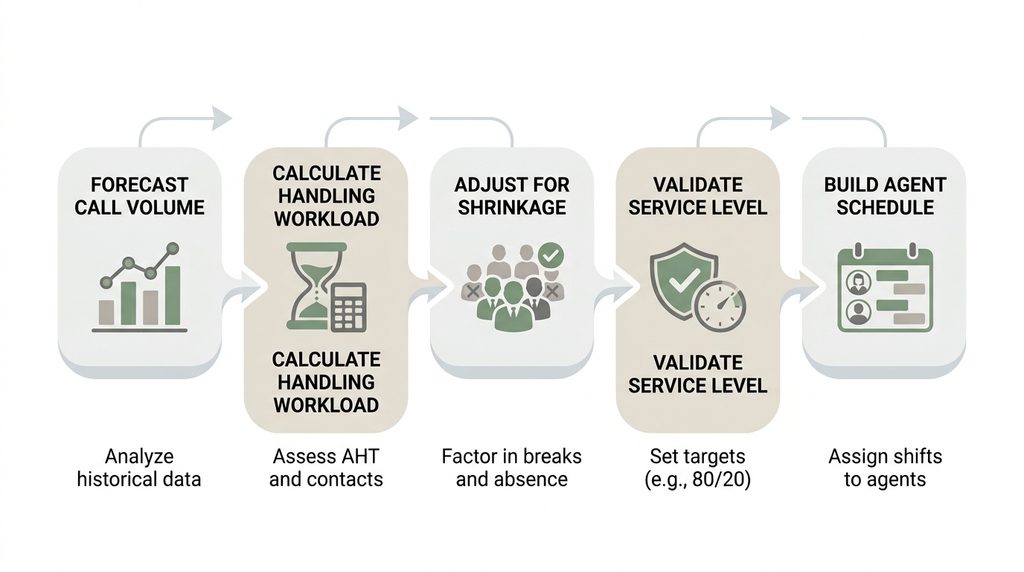
Step 1: Forecast Call Volume
Review historical call records to estimate the number of calls expected during each interval.
For example, a contact center might forecast 120 calls during a 30 minute period. Base this estimate on relevant historical data and adjust it for known changes in demand.
Avoid using daily totals alone if call volumes vary significantly throughout the day. Forecasting in shorter intervals can help identify periods when demand exceeds available capacity. See this guide to forecasting calls in 15-minute intervals for further discussion of interval-based forecasting and call arrival patterns.
Having enough agents is only one part of effective call handling. Businesses also need a clear process for directing incoming calls to the right departments, queues, and agents. Learn how to plan this process in our guide to call flow design for sales and customer support.
Step 2: Calculate the Total Handling Workload
Multiply the expected number of calls by the average handle time.
Formula: Total handling workload = Call volume × Average handle time
Suppose a contact center expects 120 calls during a 30 minute interval and the average handle time is 240 seconds.
120 × 240 = 28,800 seconds.
This is the total handling time required for the forecast calls.
Step 3: Estimate the Basic Workload Staffing
Divide the total handling workload by the length of the interval in seconds.
Formula: Basic staffing estimate = Total handling workload ÷ Interval duration
For the example above:
28,800 ÷ 1,800 = 16 agent equivalents.
This means 16 agents would provide enough combined handling time to process the forecast workload if all their time were spent handling calls.
This is only a basic workload estimate. It does not account for random call arrivals, waiting time, service level targets or agent breaks.
Step 4: Account for Shrinkage
Adjust the workload estimate to account for agents who are scheduled but unavailable to handle calls.
Formula: Scheduled staffing estimate = Required available agents ÷ (1 − Shrinkage rate)
Suppose the estimate is 16 agent equivalents and shrinkage is 25%.
16 ÷ (1 − 0.25) = 21.33.
Round up to 22 scheduled agents.
This example adjusts for shrinkage but does not establish that 22 agents will meet a particular service level.
Step 5: Validate the Estimate Against Service Targets
A basic workload formula does not account for calls arriving unevenly or several customers calling simultaneously.
For a more reliable inbound staffing plan, use a workforce management tool or an Erlang C staffing calculator. The calculator estimates the number of agents needed using call volume, average call duration and an acceptable delay. These methods provide a better basis for estimating service levels than a basic workload calculation alone.
The calculation should account for forecast call volume, average handle time, interval duration and the service level target. Include shrinkage when estimating scheduled staffing.
For a more detailed approach to forecasting contact demand and planning agent capacity, consult the official Amazon Connect forecasting and capacity planning documentation. It explains how forecasts can be used to estimate staffing needs across different planning periods and scheduling intervals.
For complex operations, assess staffing separately for different skills, channels and time periods.
Common Mistakes to Avoid When Planning Call Center Staffing
Using Daily Call Volume Alone
Daily totals can hide busy periods when demand exceeds available capacity. Forecast calls in shorter intervals to identify when additional agents may be needed.
Ignoring Shrinkage
A schedule that assumes every agent is available for every minute will underestimate staffing needs. Include breaks, training, meetings and other periods when agents cannot handle calls.
Treating the Basic Formula as the Final Answer
Dividing total workload by interval duration estimates the minimum handling capacity required. It does not predict waiting times or guarantee that service targets will be achieved.
Focusing Only on Cost
Reducing staffing may lower immediate labour costs, but it can also increase waiting times and put pressure on agents. Consider service quality and employee workload alongside cost.
Failing to Update Forecasts
Call patterns change as customer demand and business activity change. Review staffing forecasts regularly and compare them with actual performance.
How Contact Center Software Can Help With Staffing
Contact center software can give managers access to information needed for workforce planning. Depending on the platform and configuration, useful capabilities may include call volume reports, average handle time reports, real time queue monitoring, performance dashboards and workforce management integrations.
These capabilities help managers identify demand patterns and evaluate whether staffing levels are appropriate. More advanced workforce management tools can also generate interval based forecasts and staffing recommendations.
To evaluate the results of a staffing plan, managers should also track relevant call center performance metrics.
Businesses reviewing their contact center operations can explore SmartCloudContact’s omnichannel contact center services to learn about its communication and monitoring capabilities.
Frequently Asked Questions
How many agents does a call center need?
There is no universal number. Staffing depends on call volume, average handle time, service targets, operating hours, shrinkage and how demand varies throughout the day.
What is shrinkage in call center staffing?
Shrinkage is the proportion of scheduled time agents spend on activities that make them unavailable to handle customer interactions, such as breaks, training, meetings and leave.
What is the difference between workload staffing and service level staffing?
Workload staffing estimates the handling capacity needed to process expected interactions. Service level staffing also considers waiting time and the pattern of incoming calls to estimate the resources needed to meet a response target.
How often should call center staffing be reviewed?
Review staffing forecasts regularly, compare them with actual call volumes and service performance, and update the plan when demand or operating conditions change. The appropriate frequency depends on the contact center’s size and variability.
Conclusion
Calculating call center staffing requirements involves more than dividing daily call volume among available agents. Managers need to forecast demand, calculate handling workload, account for shrinkage and validate staffing against service level targets.
Start with reliable historical data and a basic workload estimate, then use an appropriate staffing model to account for waiting time and fluctuating demand. Regularly comparing forecasts with actual performance helps contact centers allocate resources more effectively and maintain consistent customer service.