
The future of customer support in Nigeria is evolving as businesses adopt digital communication tools and customers become more accustomed to interacting with brands online.
For banks, fintech companies, telecommunications providers and ecommerce businesses, meeting these expectations requires more than traditional telephone support. Artificial intelligence, workflow automation, omnichannel communication and cloud contact center technology are changing how businesses manage customer interactions.
This article explores seven important trends shaping the future of customer support in Nigeria and what businesses should consider when adopting them.
1. Artificial Intelligence Is Changing Customer Service
Artificial intelligence is creating new ways for businesses to manage customer enquiries and support agents. AI powered tools can handle certain routine interactions, assist agents and help businesses identify patterns in customer conversations.
Some important applications include:
- AI chatbots: Respond to common questions, provide basic information and guide customers through simple processes.
- Voicebots: Use conversational voice technology to handle selected routine telephone enquiries.
- Predictive analytics: Analyse available customer and interaction data to identify patterns and support operational decisions.
- Intelligent call routing: Use predefined rules and, where supported, AI based decision making to direct enquiries to suitable agents or departments.
- Agent assistance: Help human agents retrieve relevant information, summarise conversations and prepare responses.
AI does not eliminate the need for human customer service agents. Complex complaints, sensitive financial issues and situations requiring judgement may still need direct human attention.
For Nigerian businesses, the practical opportunity is to use AI to manage suitable routine tasks while allowing agents to concentrate on enquiries that require more personal attention.
2. Automation Is Reducing Repetitive Support Tasks
Customer support teams handle several administrative activities alongside their conversations with customers. Manually creating tickets, assigning enquiries, sending follow up reminders and updating customer records can consume valuable time.
Workflow automation can reduce some of this repetitive work.
Common customer support processes that can be automated include:
- Ticket creation and categorisation
- Call distribution and routing
- Follow up reminders
- Customer information updates between connected systems
- Complaint escalation
- Notifications and status updates
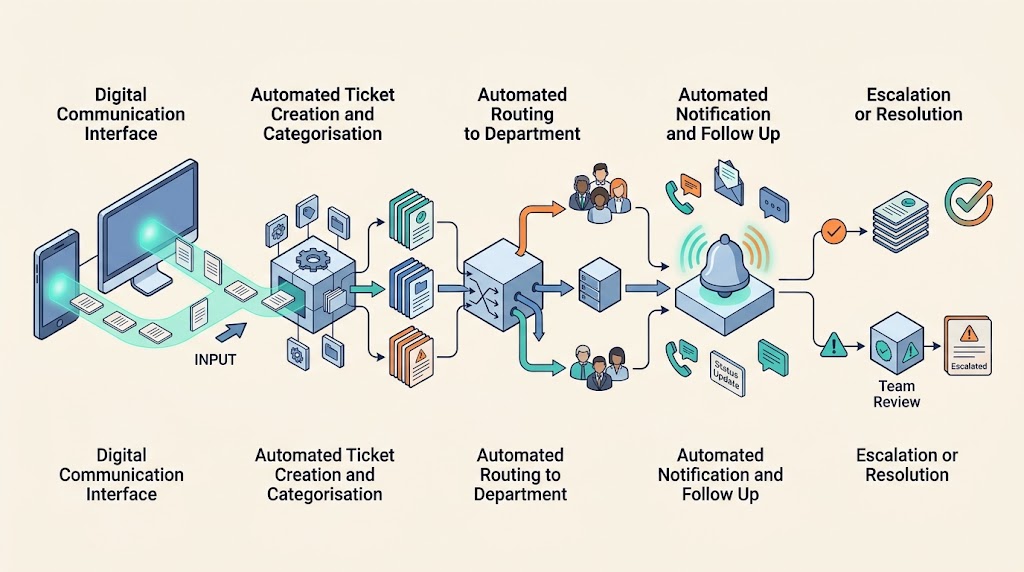
For example, when a customer submits an enquiry through a supported channel, an integrated system may automatically create a ticket, assign it to the appropriate team and notify the customer that the request has been received.
However, automation must be configured around actual business processes. Poorly designed workflows can send customers to the wrong department, create duplicate tickets or delay urgent complaints.
Businesses should identify repetitive tasks first, then automate processes that have clear rules and measurable outcomes.
3. Omnichannel Engagement Is Becoming Increasingly Important
Customers communicate with businesses through different channels, including telephone calls, WhatsApp, email, social media and website chat.
The challenge is ensuring that these channels work together rather than operating as disconnected communication points.
An omnichannel contact center brings supported communication channels into a connected environment. Depending on the platform and integrations, agents may be able to manage interactions and access relevant customer history from a shared interface.
For businesses looking to connect customer records with their communication systems, understanding CRM and contact center integrations is also important.
Common customer communication channels include:
- Voice calls
- SMS
- Facebook and Instagram
- Website live chat
- In app messaging

Benefits of Omnichannel Customer Support
A properly configured omnichannel system can help businesses:
- Maintain more consistent customer communication
- Reduce the need for customers to repeat information
- Manage enquiries from different channels in one environment
- Improve visibility into customer interactions
- Support more organised agent workflows
For example, a customer may initially contact a fintech company through WhatsApp and later call its support team. If the channels are properly integrated, an agent may be able to access the earlier interaction and continue assisting the customer without requiring them to explain the issue again.
The extent of this visibility depends on the platform, integrations and how customer records are configured.
4. Cloud Contact Centers Are Changing Traditional Call Center Operations
Traditional on premises call centers often require businesses to manage physical infrastructure, communication equipment and software installations. These requirements can make expansion and maintenance more demanding.
Cloud contact centers provide an alternative by hosting contact center software and services through cloud infrastructure.
Depending on the provider and service configuration, cloud contact center platforms can support:
- Remote agent access
- Flexible expansion of agent capacity
- Centralised communication management
- Integration with CRM and business applications
- Call reporting and performance monitoring
- Access to supported automation and AI features
Cloud based systems can be useful for Nigerian businesses that need to manage customer communication across multiple locations or support distributed teams.
For Nigerian businesses, these considerations are particularly important when choosing a cloud contact center. Internet connectivity, power availability, communication costs and the reliability of the service provider can all affect daily operations. Businesses should evaluate these factors alongside the platform’s features to ensure that the solution fits their working environment.
However, moving to the cloud does not automatically guarantee better security, reliability or lower costs. Businesses should assess internet connectivity, service availability, data protection, access controls, support arrangements and the provider’s pricing model before choosing a platform.
Businesses exploring cloud communication can also learn more about contact center services in Nigeria.
5. WhatsApp Business Integration Will Remain an Important Consideration
WhatsApp is an important communication channel for many businesses and customers in Nigeria. Its familiarity makes it useful for enquiries, customer updates and ongoing communication.
The WhatsApp Business Platform allows eligible businesses to integrate WhatsApp messaging into their customer communication systems through supported providers and integrations.
Possible customer support applications include:
- Automated responses to common enquiries
- Order and service notifications
- Customer support conversations
- Message routing to available agents
- Integration with CRM or ticketing systems
- Conversation management across supported channels
Businesses should distinguish between the WhatsApp Business app and the WhatsApp Business Platform. The latter is designed to support business messaging integrations and larger communication workflows.
WhatsApp automation also requires appropriate configuration. Businesses must consider messaging permissions, approved message templates where applicable, customer consent and the platform’s messaging policies.
Learn more from the official WhatsApp Business Platform.
6. Real Time Analytics Will Support Better Decisions
Customer support generates operational data that can help businesses understand demand, monitor service quality and identify areas that need improvement.
Modern contact center platforms may provide reporting and analytics for metrics such as:
- Average handling time: The average time spent handling customer interactions, including relevant follow up work.
- First contact resolution: The proportion of enquiries resolved during the initial interaction.
- Customer satisfaction: Feedback collected from customers about their support experience.
- Queue waiting time: How long customers wait before reaching an agent.
- Abandoned interaction rate: The proportion of customers who leave a queue before receiving assistance.
- Agent performance: Measures of workload, activity and service quality.

These metrics should be interpreted together. For example, reducing average handling time is not necessarily an improvement if agents are rushing customers or failing to resolve their issues.
Nigerian businesses can use contact center analytics to identify recurring complaints, understand busy periods, allocate resources and improve support processes.
7. Remote Customer Support Teams Are Becoming More Flexible
Cloud technology has made it possible for some businesses to manage customer support agents across different locations.
Instead of requiring every agent to work from one physical office, businesses can use supported cloud systems to coordinate distributed teams.
Depending on the platform, remote support operations may include:
- Secure agent authentication
- Role based access controls
- Centralised call and interaction management
- Remote training and onboarding
- Performance monitoring
- Quality assurance processes
This model can give businesses more flexibility when recruiting and organising support teams. However, remote operations require reliable internet access, suitable devices, clear supervision processes and appropriate security controls.
Businesses should establish clear policies for customer data access, device usage and the handling of sensitive information.
What Nigerian Businesses Should Consider When Adopting These Trends
Adopting new customer support technology requires more than choosing a platform with the largest feature list. Businesses should evaluate their actual communication needs and operational requirements.
Important considerations include:
- Customer communication channels: Identify the channels your customers use most and prioritise the integrations your business needs.
- Integration requirements: Confirm whether the platform connects with your existing CRM, ticketing, payment or business applications.
- Automation suitability: Start with repetitive processes that have clear rules and measurable outcomes.
- Security and data protection: Review access controls, data handling practices and relevant Nigerian data protection requirements.
- Internet and infrastructure: Consider connectivity requirements and how service interruptions will be managed.
- Scalability and pricing: Understand how costs change as your business adds agents, channels or additional features.
- Reporting and service quality: Ensure that the platform provides useful metrics for evaluating customer support performance.
Businesses should also review applicable guidance from the Nigeria Data Protection Commission when handling personal data.
How SmartCloudContact Supports Modern Customer Communication
Modern contact center technology can help businesses organise customer conversations, manage communication channels and monitor support operations.
SmartCloudContact provides contact center solutions for businesses looking to manage their customer communication through a more connected environment.
Businesses evaluating a contact center platform should consider the available communication channels, integration options, reporting capabilities and automation features to determine whether the solution meets their operational requirements.
To explore available services, visit SmartCloudContact’s contact center services page.
Conclusion: The Future of Customer Support Is Connected and Intelligent
The future of customer support in Nigeria will be shaped by artificial intelligence, workflow automation, omnichannel engagement, cloud technology and data driven decision making.
These technologies create opportunities for businesses to organise customer interactions, reduce repetitive work and improve the way support teams operate. However, their value depends on selecting suitable tools, implementing them properly and measuring their impact on customer experience.
For Nigerian businesses, the goal should not simply be to adopt every new technology. It should be to build a customer support system that is accessible, reliable, secure and capable of meeting changing customer expectations.